
01. Process & Research
Behind Recon Engage
gamifying experiences
Field research on the mountain, designing for extreme conditions, and the design decisions that turned raw telemetry into a social sports platform.
02. Research & Discovery
Designing for extreme environments
Recon’s users weren’t sitting at desks. They were at altitude, wearing gloves, moving fast, and making split-second decisions. Understanding this required contextual research on the mountain – not in a lab.
"Users weren't just driven by performance data. They wanted bragging rights. Jump counts and top speeds were social currency - and that completely changed the design direction."
01. Direct observation
Goggle sync flows
02. Post-run interviews
Motivation & habits
03. Focus group testing
UI & data clarity
04. Hardware constraints
Glove + cold UX
05. Field prototype testing
Instant iteration

Key research findings
Data analysis revealed four compounding failure points in the onboarding funnel. Each was addressed in sequence – fixing upstream problems first so downstream metrics would follow.
01. Data as social currency
Users were motivated not just by personal performance, but by comparison and "bragging rights." Jump counts and top speeds were conversation starters - metrics that needed to be shareable, not just recorded.
02. The post-run ritual was broken
The natural moment to review and share a run - immediately after coming off the mountain - was being missed because desktop-only access meant a delay of hours before users could see their data.
03. Goggles needed a digital extension
Riders experienced a jarring break between the in-goggle HUD experience and the rest of their digital lives. The app needed to feel continuous with the mountain - not like a separate product.
04. Gloves changed everything
Any interface requiring fine motor control failed immediately. Small tap targets, complex navigation, and text input were all non-starters. The design constraints for the Virtual Remote were extreme - large touch areas, minimal steps, voice-of-confirmation feedback.
03. Design constraints
Designing for the mountain, not the desk
Recon’s users operated in conditions that invalidated most standard UX conventions. Every design decision had to pass three environment tests before it was considered viable.
Cold & gloved hands
Minimum 44px tap targets. No pinch/zoom. Single-thumb navigation throughout. Tested on-site with ski gloves.
High-altitude sunlight
High-contrast UI with no reliance on subtle color differences. Tested at different brightness levels and on screens in direct sunlight.
Goggle HUD parity
Visual language and data labelling had to align across the mobile app, web platform, and the goggle display itself - all surfaces simultaneously.
Data analysis revealed four compounding failure points in the onboarding funnel. Each was addressed in sequence – fixing upstream problems first so downstream metrics would follow.
04. Core design decision
From raw telemetry to social fuel
The most consequential design challenge was translating machine data – GPS coordinates, g-force readings, gyroscope outputs – into metrics that meant something to a rider. The same data point needed to read differently depending on context: as a performance metric in the Trip Viewer, as a challenge in Buddy Tracking, and as a shareable achievement in the social feed.
Raw telemetry
GPS · speed · altitude · jumps
Recon Engage
Design system Context engine
App Features
Trip Viewer - Route analysis & replay Buddy Tracking - Real-time challenge Sharing - Achievements & bragging rights
The Trip Viewer was the most data-rich surface – interactive maps, run-by-run timelines, and overlaid performance graphs. Buddy Tracking required the same data but stripped to a single competitive metric. The social share reduced everything to a single highlight card – the one number a rider would want to show a friend. Designing the same data at three different densities from a shared component system was the central UX challenge of the project.

05. Design system
One language across three surfaces
The design system had an unusual constraint: it had to work across mobile, web, and the in-goggle HUD display simultaneously. Colours, typographic hierarchy, and data labelling all needed to remain consistent whether a user was looking at their phone, a browser, or their goggle’s field of view.
Mobile app
iOS · post-run sync · remote
Web platform
Trip Viewer · e-commerce · social
Goggle HUD
In-run display · data overlay
Shared component library
Data displays · Maps · Metric cards · Navigation · Stats · Buttons
Foundations
Design tokens · High-contrast colour system · Type scale · Data labelling conventions · Glove-safe touch targets

06. Design Process
Test on the mountain, iterate on the fly
The project timeline was dictated by the ski season – a hard deadline that made rapid prototyping and field testing non-optional. Prototypes were in riders’ hands the same week they were built.
01. Contextual research - slope-side observation
Observed snowboarders and skiers syncing goggles post-run to document natural workflows. Focus groups tested early concepts for data display clarity and social sharing mechanics.
02. Design system - foundations first
Established the foundational token set, high-contrast colour system, and data labelling conventions before designing any feature screens - ensuring consistency across mobile, web, and the goggle HUD from the start.
03. Prototyping - Trip Viewer and Buddy Tracking
Built interactive Figma flows for the two highest-value features before any development work began. These prototypes were used in both user testing and stakeholder alignment sessions with product leadership.
04. Field testing - immediate post-session feedback
Tested prototypes with riders immediately after their runs - capturing feedback while the experience was still fresh. Iterated on the post-run sync flow specifically after discovering technical drop-off points were stalling adoption.
05. E-commerce redesign - data-informed conversion focus
Led focus group testing and user interviews specifically for the web store redesign. Translated findings into a simplified checkout flow optimised for the 2012/2013 seasonal sales window.
06. Migration - desktop to mobile launch
Prioritised the post-run sync process to ensure technical adoption wouldn't stall. The 85% desktop-to-mobile migration by the end of the 2012 winter season validated the approach.
07. Reflections
What I learned
What worked
- Field testing in real conditions caught usability failures that lab testing would have missed entirely - the glove problem only became apparent on-mountain
- Designing the data system before any feature screens ensured the three surfaces stayed visually consistent throughout the project
- Reducing the social hook to a single metric per context (one number to share, one number to challenge) made the gamification feel clean rather than overwhelming
- Treating the post-run sync flow as the critical retention moment - not just a technical step - directly drove the 85% migration rate
What I'd do differently
- Instrument the e-commerce store with analytics from day one to capture conversion data during the 2012/2013 launch window - we relied on qualitative feedback rather than funnel data
- Design the social share format earlier - it was treated as a feature extension rather than a core retention mechanic, and could have been more central to the initial launch
- Build a formal accessibility test protocol for the high-altitude, high-glare display scenario - we validated against gloves but didn't have a structured sunlight-contrast testing process
Recon Instruments
Mobile & Web Platform
Jul 2011 – Mar 2013
Led the design of Recon’s first mobile and web applications – transforming raw goggle telemetry into a connected, gamified sports platform and migrating 85% of the desktop community to mobile within a single season.
The Final Result

A community of elite snow sports athletes transitioned from a tethered desktop app to a seamless mobile and web ecosystem.
The Challenge
Recon’s hardware was pioneering — live speed, GPS, and jump data in your goggles — but the experience ended when you left the mountain. Users could only access their data on desktop, and there was no social layer to share achievements or compete with friends. The gap between the in-goggle experience and the rest of a rider’s digital life was killing retention and limiting the brand’s growth.
- Desktop-only access cut users off post-run
- Raw telemetry data had no social or gamified context
- No mobile sync meant the post-run ritual was broken
- Glove-unfriendly interfaces made on-mountain use painful


My Role
Jul 2011 – Mar 2013
Senior UX/UI Designer across a 21-month engagement. I owned the design of the Recon Engage mobile and web platforms from the ground up – establishing the design system, leading e-commerce redesign for the 2012/2013 launch, and shaping the data vizualisation experience that turned raw telemetry into social fuel.
- Product vision & go-to-market strategy
- Design system (Figma)
- Payments onboarding flows
- KYC & address verification UX
- Checkout redesign
- Usability & conversion testing
Four pillars of the platform
The Recon Engage platform was built around four interconnected features – each one extending the in-goggle experience into the rider’s broader digital life and social world.


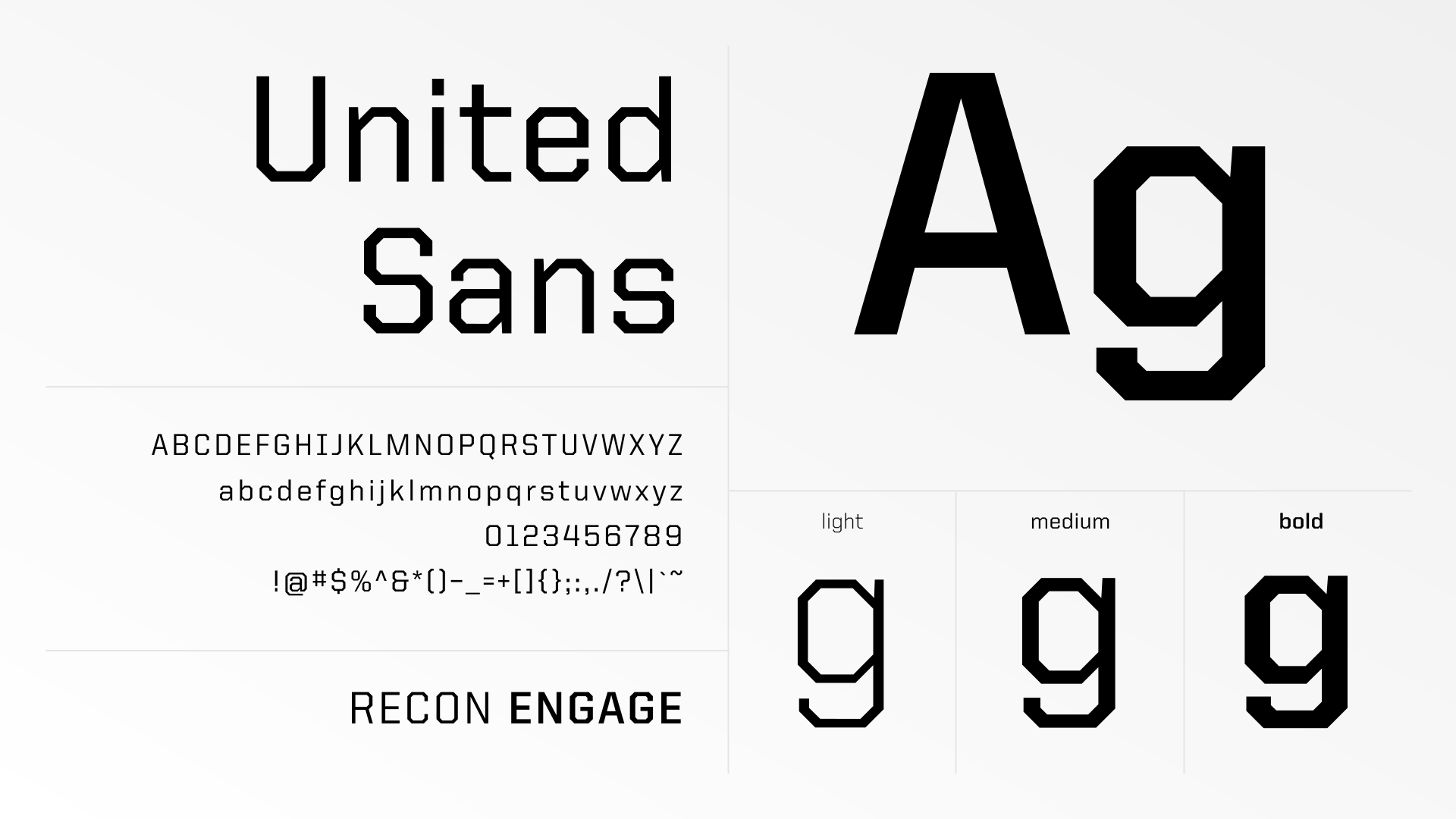
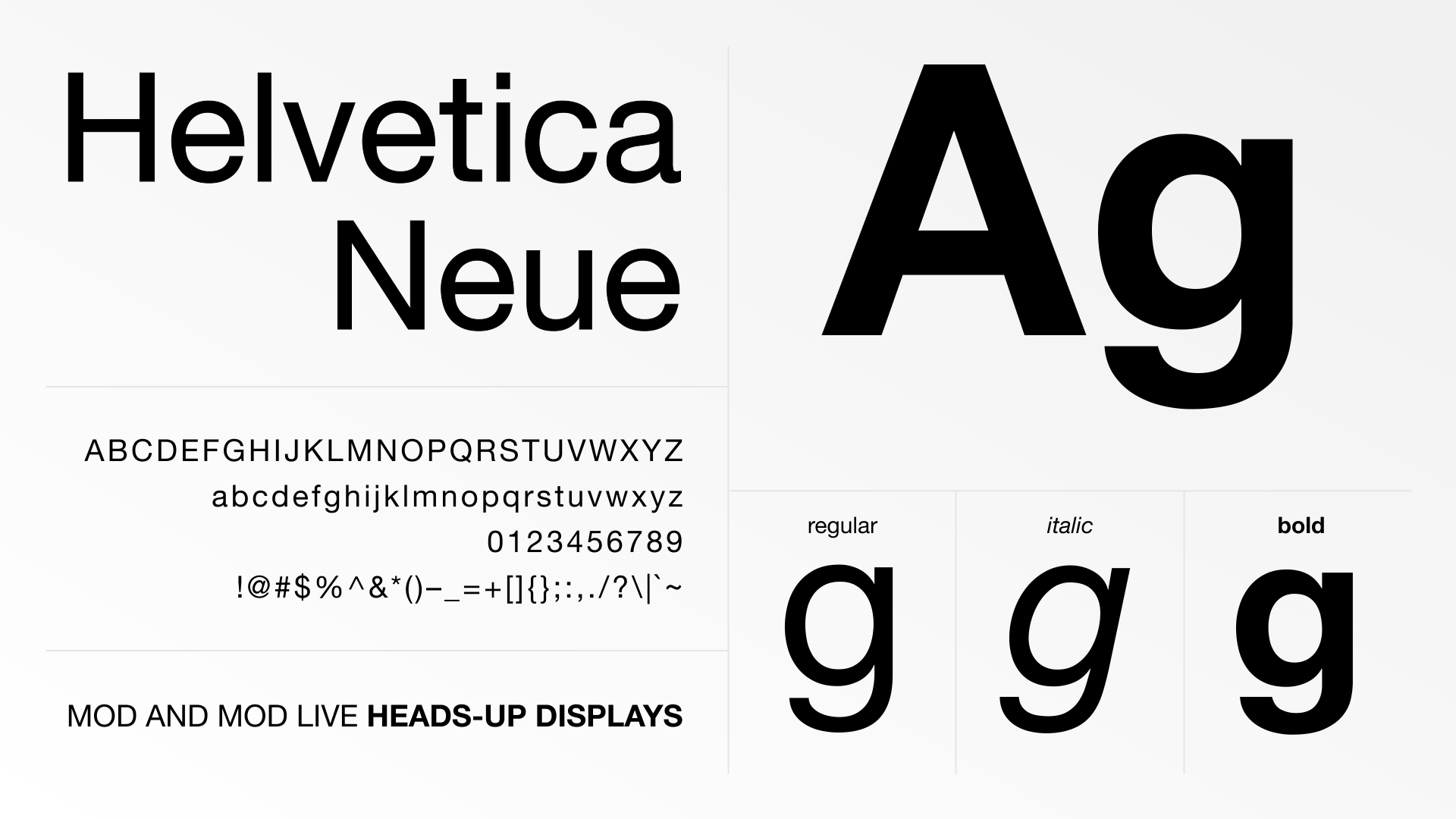
Typography & Color Scheme
Recon’s users operated in conditions that invalidated most standard UX conventions.




From data tracker to social platform
The platform launched in time for the 2012 winter season and achieved rapid community migration. Recon’s work on wearable display UX – much of which was pioneered in this platform – positioned the company as an early leader in augmented reality, leading to its acquisition by Intel in 2015.
- 85% of Recon HQ desktop users migrated to the new mobile platform by the 2012 winter season
- Foundational design system established for Recon Engage web and mobile – scalable across all platform surfaces
- E-commerce store redesign optimised checkout and user journey for the 2012/2013 seasonal sales launch
- Telemetry data transformed into social, gamified experiences – jump counts and top speeds became shareable achievements
- Virtual Remote solved the glove-usability problem that had limited on-mountain engagement with the goggle interface
- Recon acquired by Intel in 2015 – platform work positioned the brand as a leader in early AR/wearable tech
Want to see how it was built?
The process page covers the contextual field research, how telemetry data was designed for social consumption, the design system architecture, and the e-commerce redesign approach.


